Saturday, 27 November 2010

Regent bowerbird

Sericulus chrysocephalus

Photo by Josep del Hoyo (Internet Bird Collection)


Common name:
regent bowerbird (en); jardineiro-governador (pt); jardinier prince-régent (fr); pergolero regente (es); gelbnacken-laubenvogel (de)

Taxonomy:
Order Passeriformes
Family Ptilonorhynchidae

Range:
This Australian species is only found in the coastal rainforests of south-eastern Queensland and north-eastern New South Wales, in the eastern-most part of Australia.

Size:
The regent bowerbird is 25-30 cm long. They can weigh up to 100 g.

Habitat:
They are found in forested areas, mostly rainforests and their surrounding areas.

Diet:
They mostly eat fruits and berries in the canopy and upper layers of the forests. These may be seasonally supplemented with insects, spiders, plant shoots and leaves.

Breeding:
The breding season of the regent bowerbird takes place in September-March. The male will not participate in either nest building of raising the young. He builds an avenue-type bower consisting of two walls of sticks, decorated with shells, seeds, leaves and berries that is used to attract females. The actual nest is built by the female, a shallow saucer of twigs and leaves that may be well away from the male's bower. The clutch is composed of 1-2 eggs, which are incubated by the female for 25 days. The chicks stay in the nest for 22 days before fledging.

Conservation:
IUCN status - LC (Least Concern)
This species as a large breeding range. Although the population is believed to be declining due to ongoing habitat loss and degradation, and unquantified levels of hunting, the species is not considered threatened at present.

Friday, 26 November 2010

Madagascar kestrel

Falco newtoni

Photo by Alberto Rios (Internet Bird Collection)

Common name:
Madagascar kestrel (en); peneireiro-de-Madagáscar (pt); crécerelle malgache (fr); cernícalo de Madagascar (es); Madagaskarfalke (de)

Taxonomy:
Order Falconiformes
Family Falconidae

Range:
This species occurs in Madagascar, Mayotte, the Comores, and in the Aldabra atoll, in the Seychelles.

Size:
This small raptor is 30 cm long and has a wingspan of 38-42 cm. The males weigh 112-118 g. The females are slightly larger weighing up to 128 g.

Habitat:
The Madagascar kestrel can be found from sea level up to an altitude of 2000 m. They occur in any vegetation-covered open habitat, as well as in grasslands, croplands and secondary vegetation. They are also common in the vicinity of human settlements which may be the preferred habitat in some areas. They are uncommon in forests.

Diet:
They mostly eat insects, particularly grasshoppers, which are taken during flight. They can also hunt small birds, frogs, lizards and mammals.

Breeding:
The Madagascar kestrel nests on rock ledges, in buildings, tree holes or even in the nests of other birds, like the pied crow Corvus albus. Egg laying usually takes place in September. Each clutch is composed of 3-5 rufous-coloured eggs, which are incubated by the female for 27-29 days. The male feeds the female during incubation. The chicks are fed by both male and female until fledging, which takes place 23-24 days after hatching. The young disperse from the natal area at about 44-45 days of age.

Conservation:
IUCN status – LC (Least concern)
This species as a large breeding range and a population estimated at 100.000 individuals. The population is increasing owing to an increase in suitable habitat caused by cultivation, urbanization and deforestation. Overall the species is not considered threatened at present.

Thursday, 25 November 2010

Chinstrap penguin

Pygoscelis antarctica

(Photo from Antarctic Field Guide)

Common name:

Taxonomy:
Order Sphenisciformes
Family Spheniscidae

Range:
The chinstrap penguin breeds mostly on islands of the southern seas, namely in South Orkney, South Shetland, South Georgia and South Sandwich, and on the Antarctic Peninsula as far south as Anvers. They winter in the seas around the pack ice of Antarctica.

Size:
These penguins are 68-76 cm long. Their weight has large variations throughout the yearly cycle, ranging from 3-6 kg.

Habitat:
They live both on barren islands and large icebergs of the sub-Antarctic and Antactic regions. However, they require solid, snow-free ground to nest on. They mostly forage near the pack ice and are only occasionally found foraging further out to sea.

Diet:
The chinstrap penguin mostly feeds on krill. They also eat other small crustaceans, small fish and squids. When hunting they can dive up to 60 m for about 60 seconds.

Breeding:
They use stones to build circular nests on the ground. In November-December the females lay 2 eggs. The eggs are incubated by both the male and the female for shifts of 6 days. The chicks hatch after 37 days and stay in the nest for another 20-30 days before joining a creche. At around 50-60 days old they are able to go out to sea.

Conservation:
IUCN status - LC (Least Concern)
With a very large breeding range and a population estimated at 8 million, the chinstrap penguin is not threatened at present. Despite this, commercial krill fishing and tourist activities are regulated near their breeding colonies to minimize impacts on the species.

Wednesday, 24 November 2010

Indian pitta

Pitta brachyura

Photo by Nidhin Poothully (Wikipedia)

Common name:

Taxonomy:
Order Passeriformes
Family Pittidae

Range:
This species breeds in the foothills of the Himalayas, in northern India, Pakistan and Nepal. They winter in southern India and Sri Lanka.

Size:
The Indian pitta is medium-sized passerine, 15-19 cm long. They weigh 47-66 g.

Habitat:
They breed in the under-story of evergreen and deciduous forests, often near ravines with dense brush or bamboo. During migration and winter they use forested areas, including small fragments and wooded gardens.

Diet:

They forage for invertebrates in the leaf-litter of the forest floor. Food items include ants, termites, insect larvae, slugs, snails, millipedes, and earthworms. They can also eat fruits and have been noted to take kitchen food scraps from the ground.

Breeding:
Indian pittas breed during the monsoon season, in June-August. The nest is a globular structure with a circular opening on one side, built on the ground or on low branches with dry leaves and grasses. The clutch consists of 4-5 glossy white eggs with brown or purple spots and speckles. Both parents share the task of incubation for 14-16 days. The altricial chicks are fed and brooded by both parents for 11-17 days until fledging. They continue to be fed by the adults for a few weeks after fledging.

Conservation:
IUCN status - LC (Least Concern)
The global population of this species as not been quantified, but the species is described as not uncommon. They are believed to be declining as a result of ongoing forest clearance to make way for agriculture and urban development. During migration, they are also caught in large numbers human consumption. Despite this, the species is not considered threatened at present.

Tuesday, 23 November 2010

Blue tit

Cyanistes caeruleus

(Photo from Wallpaper Pond)

Common name:

Taxonomy:
Order Passeriformes
Family Paridae

Range:
The blue tit is widely distributed in Europe, from Scandinavia in the north down to the Mediterranean and from the British Islands in the west all the way to the Urals in Russian. They are also present in northwest Africa and the Canary Islands, and in the Near East, through Turkey and the Caucasus, and all the way to northwestern Iran.

Size:
This small passerine is 10,5-12 cm long. They have a wingspan of 18 cm and weigh 11 g.

Habitat:
The blue tit uses a wide range of habitats. They are most frequently found in deciduous woodland, in pasture farmland, and in gardens and parks within villages and towns. They can also be found in scrubland and arable farmland, and even in vegetated coastal and inland wetlands.

Diet:
In the spring and summer they are mostly carnivorous, eating spiders and insects, including several agricultural pests like coccids and aphids. In the winter they mostly eat fruits and berries.

Breeding:
The blue tit will nest in any suitable hole in a tree, wall, or stump, or an artificial nest box. In April-May they lay 8-10 eggs, which are incubated for 13-15 days by the female. The altricial chicks fledge after 18-21 days. Blue tits start breeding at 1 year of age and produce 1 to 2 broods per year.

Conservation:
IUCN status - LC (Least concern)
The blue tit population is estimated at 10 million and believed to be increasing. The already large breeding range is also increasing, both justifying that the species is not considered threatened at present.

Monday, 22 November 2010

Pallid cuckoo

Cuculus pallidus

Photo by Larry Dunis (Bushpea)

Common name:
pallid cuckoo (en); cuco-pálido (pt); coucou pâle (fr); cuco pálido (es); blaßkuckuck (de)

Taxonomy:
Order Cuculiformes
Family Cuculidae

Range:
They are found throughout Australia, Tasmania and New Zealand, and migrate north to winter in Papua New Guinea, Indonesia and Christmas Island.

Size:
The pallid cuckoo is 28-33 cm and weighs an average 89 g.

Habitat:
The pallid cuckoo inhabits subtropical or tropical dry forests and subtropical or tropical mangrove forests. They mostly use open forests, as well as cleared and cultivated open country near forests.

Diet:
They mostly eat insects and caterpillars taken from foliage.

Breeding:
The pallid cuckoo lays its eggs in the nests of honeyeaters, woodswallows, whistlers and flycatchers. Common host species include the Willie wagtail Rhipidura leucophrys and the hooded robin Melanodryas cuculatta. The female cuckoo removes one of the host's eggs and replaces it with one of her own. The cuckoo egg usually closely resembles the host egg but hatches before the others, after which the young cuckoo instinctively forces the other eggs (or chicks) out of the nest. The young cuckoo is fed by its “foster” parents until fledging, often becoming larger than them.

Conservation:
IUCN status – LC (Least concern)
Although there is no reliable population estimate, the species has a very large breeding range and is suspected to be increasing as ongoing habitat degradation may be creating new areas of suitable habitat. This supports the assertion that the pallid cuckoo is not threatened at present.

Sunday, 21 November 2010

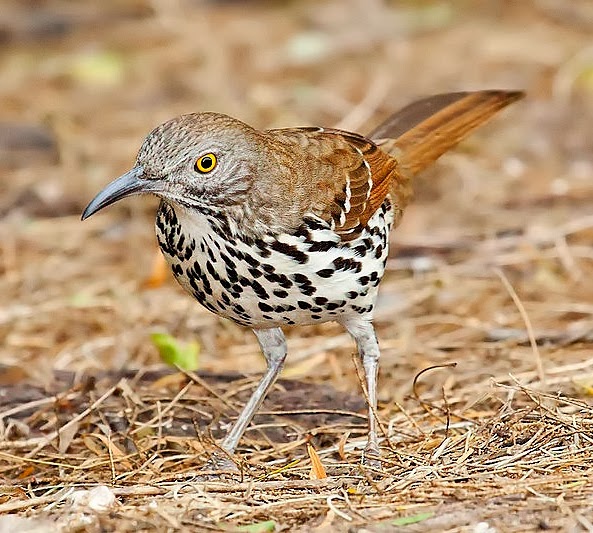
Long-billed thrasher

Toxostoma longirostre

Photo by Bill Bouton (Wikipedia)

Common name:
long-billed thrasher (en); sabiá-de-bico-longo (pt); moqueur à long bec (fr); cuitlacoche de pico largo (es); langschnabel-spottdrossel (de)

Taxonomy:
Order Passeriformes
Family Mimidae

Range:
This North American species is only found in southern Texas and northeast Mexico, between Tamaulipas and Veracruz.

Size:
These slender birds are 26,5-29 cm long and have a wingspan of 33 cm. They weigh on average 68 g.

Habitat:
They occur in a variety of scrubby of thicketed habitats, namely along riparian woodland and mesquite.

Diet:
The long-billed thrasher is an omnivorous bird, eating mostly grasshoppers, beetles, spiders, snails, slugs and various kinds of berries.

Breeding:
They build a bulky cup-shaped nest in thick low or mid-height vegetation. The nest is mostly made of twigs and grasses. The females lay 2-5 bluish-white eggs with dense reddish-brown and gray speckles. The eggs are incubated for 13-14 days by both parents. The chicks are fed by both parents and fledge after 12-14 days. Long-billed thrashers may produce two broods per year.

Conservation:
IUCN status - LC (Least Concern)
With a current population estimated at 400.000 individuals, this species has undergone a large and significant increase over the last 40 years. Consequently, the species is not threatened at present.