Friday, 7 June 2013

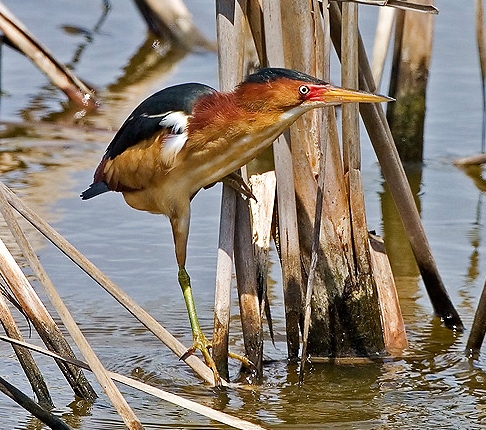
Least bittern

Ixobrychus exilis

Photo by Harold Stiver (Nature Notes)

Common name:
least bittern (en); socoí-vermelho (pt); petit blongios (fr); avetorillo panamericano (es); Amerikanische zwergdommel (de)

Taxonomy:
Order Ciconiiformes
Family Ardeidae

Range:
This species is found from south-eastern Canada and the eastern, southern and south-western United States, through Central America and into the coasts and along the main rivers and wetlands of South America as far south as south-eastern Brazil and Paraguay. The populations in North America migrate south to winter in Central America.

Size:
These birds are 28-36 cm long and have a wingspan of 41-46 cm. They weigh 50-110 g.

Habitat:
The least bittern is found in a wide range of coastal and inland wetlands, including saltmarshes, mangroves, fresh water marshes and swamps, lakes with dense vegetation, rivers and artificial channels and ditches. They are present from sea level up to an altitude of 3.100 m.

Diet:
They mainly feed on small fishes, crustaceans and aquatic insects, but also amphibians, reptiles and terrestrial insects. They can also eat the eggs and chicks of other marsh-dwelling birds.

Breeding:
Least bitterns are loosely colonial. The male builds the nest, which consists of a frail platform of sticks and twigs, placed over water on dead stalks of emergent vegetation. There the female lays 2-5 bluish-white eggs with brown flecks, which are incubated by both parents for 19-20 days. The chicks are fed by both parents and fledge about 25 days after hatching. Each pair can raise 1-2 broods per season.

Conservation:
IUCN status - LC (Least Concern)
This species has a very large breeding range. There is no information regarding population size or global trends, but some populations are known to be in decline, due to habitat loss caused by drainage of wetlands and human disturbance during the nesting period. In North America the least bittern has had a stable trend over the last 4 decades.

Thursday, 6 June 2013

Black-chinned laughingthrush

Strophocincla cachinnans

Photo by Niranjan Sant (Oriental Bird Images)

Common name:
black-chinned laughingthrush (en); zaragateiro-de-garganta-preta (pt); garrulaxe des Nilgiri (fr); chalátan de Nilgiri (es); zimtbrusthäherling (de)

Taxonomy:
Order Passeriformes
Family Timaliidae

Range:
This species is endemic to southern India, only being found in north-western Tamil Nadu, north-eastern Kerala and south-western Karnataka, predominantly in the Nilgiri Hills, and with a smaller disjunct population in the Palakkad-Siruvani Hills.

Size:
These birds are 20-24 cm long.

Habitat:
The black-chinned laughingthrush is mostly found in dense understory of tropical moist forests and also in scrublands, plantations and gardens at altitudes of 1.200-2.300 m.

Diet:
They feed on invertebrates, nectar, flowers, fruits and berries.

Breeding:
Back-chinned laughingthrushes breed in January-June. The nest is a deep cup made of fine twigs, moss, grass and dead leaves, and lined with moss roots, fibres, fine grass, wool, and fur. It is placed in a scrub or tree, usually 1-2 m above the ground. The female lays 2 greenish blue eggs with brown blotches, which are incubated by both parents for 16-17 days. The chicks are fed by both parents and fledge 15-18 days after hatching, but only become fully independent 3 weeks later.

Conservation:
IUCN status - EN (Endangered)
This species has a relatively small breeding range and a global population estimated by 2.500-10.000 individuals. The population is suspected to be declining at a moderate rate, owing to the degradation and loss of habitat. Many of the forests within their range are being converted into plantations, reservoirs, crops and human settlements. The indiscriminate use of inorganic pesticides may also be a problem. Having a mountainous distribution that is close to the maximum altitude within its range, this species is potentially susceptible to climate change.

Wednesday, 5 June 2013

Striped treehunter

Thripadectes holostictus

Photo by William Price (Internet Bird Collection)

Common name:
striped treehunter (en); trepa-musgos-listado (pt); anabate strié (fr); trepamusgos listado (es); strichelbaumspäher (de)

Taxonomy:
Order Passeriformes
Family Furnariidae

Range:
This South American species is found along the eastern slopes of the Andes, from south-western Venezuela to central Bolivia.

Size:
These birds are 20-21 cm long.

Habitat:
The striped treehunter is mostly found on the undergrowth of mountain rainforests, but also in degraded patches of former forests, at altitudes of 900-3.000 m.

Diet:
They hunt among dense vegetation, taking various invertebrates.

Breeding:
Striped treehunters breed in October-January. They nest is made of rootlets and placed in a burrow excavated into a steep bank or vegetation-covered road-cut. The female lays 2-3 eggs which are are incubated for 13-17 days. The chicks are fed by both parents and fledge 20-23 days after hatching.

Conservation:
IUCN status - LC (Least Concern)
This species has a large breeding range and is described as fairly common. This population is suspected to be stable in the absence of evidence for any declines or substantial threats.

Tuesday, 4 June 2013

Blue-breasted kingfisher

Halcyon malimbica

Photo by Manu Romero (MRP Animales)

Common name:
blue-breasted kingfisher (en); guarda-rios-de-peito-azul (pt); martin-chasseur à poitrine bleue (fr); alción pechiazul (es); zügelliest (de)

Taxonomy:
Order Coraciiformes
Family Alcedinidae

Range:
This species is found in sub-Saharan Africa, from Senegal to Uganda and Tanzania, northern D.R. Congo and northern Angola.

Size:
These birds are 20-30 cm long and weigh 65-95 g.

Habitat:
The blue-breasted kingfisher is mostly found in moist tropical forests, but also in mangroves, flooded grasslands, inland wetlands such as lakes, river and freshwater marshes, and nearby dry savannas and plantations. They are present from sea level up to an altitude of 1.800 m.

Diet:
They feed on large insects and other arthropods, frogs, fishes and also the fruits of oil palms.

Breeding:
Blue-breasted kingfishers can breed all year round, varying between different parts of their range. They nest in holes excavated into arboreal termite nests, usually 6-10 m above the ground. There the female lays 2 eggs which are incubated for 18-22 days. There is no information regarding the length of the fledgling period.

Conservation:
IUCN status - LC (Least Concern)
This species has a very large breeding range and is described as widespread and uncommon to common. The population is suspected to be declining locally owing to ongoing habitat destruction.

Monday, 3 June 2013

Plumbeous sierra-finch

Phrygilus unicolor

Photo by Mauricio Rueda (Internet Bird Collection)

Common name:
plumbeous sierra-finch (en); canário-andino-cinzento (pt); phrygile gris-de-plomb (fr); yal plomizo (es); bleiämmerling (de)

Taxonomy:
Order Passeriformes
Family Emberizidae

Range:
This species is found from Venezuela to Tierra del Fuego, mostly along the eastern slopes of the Andes.

Size:
These birds are 13-15 cm long and weigh 20-25 g.

Habitat:
The plumbeous sierra finch is mostly found in high-altitude grasslands and scrublands, and also in pastures, at altitudes of 3.000-4.500 m.

Diet:
They feed on seeds, fruits, berries and buds.

Breeding:
Plumbeous sierra-finches nest in an open cup lined with fine plant materials and hairs, placed in a sandy cliff or crevices among rocks. There the female lays light blue-green eggs with reddish-brown spots, which she incubates alone for 2 weeks. The chicks are fed by both parents and fledge 3 weeks after hatching.

Conservation:
IUCN status - LC (Least Concern)
This species has a very large breeding range and is described as fairly common. The population is suspected to be stable in the absence of evidence for any declines or substantial threats.

Sunday, 2 June 2013

Tui

Prosthemadera novaeseelandiae

Photo by Sid Mosdell (Wikipedia)

Common name:
tui (en); melífago-tui (pt); méliphage tui (fr); mielero tui (es); tui (de)

Taxonomy:
Order Passeriformes
Family Meliphagidae

Range:
This species is endemic to New Zealand, where it is found throughout North Island, along the western and southern coasts of South Island, in Stewart Island, the Chatham Islands, Raoul in the Kermadec Islands and in the Auckland Islands.

Size:
These bird are 30 cm long. The males tend to be larger and weigh 95-200 g while the females weigh 70-165 g.

Habitat:
The tui is mostly found in temperate and sub-Antarctic forests, but also in open rural areas and within urban areas.

Diet:
They mainly feed on nectar, but will also eat fruits and sap. Occasionally, they also take invertebrates.

Breeding:
Tuis breed in September-January. The nest is an open cup made of twigs and sticks, and lined with leaves, ferns and moss. It is placed in a fork or the outer branches of a tree or tall scrub, 2-6 m above the ground, often well hidden among thick vines. The female lays 3-4 white or pink eggs with reddish-brown speckles, which she incubates alone for 14 days. The chicks fledge 11 days after hatching.

Conservation:
IUCN status - LC (Least Concern)
This species has a large breeding range and a global population estimated at 2.500-10.000 individuals. The population is suspected to be in decline owing to ongoing habitat destruction and the effects of introduced species, but it is not considered threatened at present.

Saturday, 1 June 2013

Common ringed plover

Charadrius hiaticula

Photo by Laurent Demongin (Internet Bird Collection)

Common name:
common ringed plover (en); borrelho-grande-de-coleira (pt); pluvier grand-gravelot (fr); chorlitejo grande (es); sandregenpfeifer (de)

Taxonomy:
Order Charadriiformes
Family Charadriidae

Range:
This species breeds in northern Russia, Scandinavia, Greenland and Iceland, and also in the British Island and along the Baltic and Atlantic coasts of Europe down to western France. Most populations migrate south to winter along the coasts of Europe, Africa, the Middle East and southern Asia as far east as south-eastern India.

Size:
These birds are 18-20 cm long and have a wingspan of 48-57 cm. They weigh 40-80 g.

Habitat:
The common ringed plover breeds in mostly on sand or shingle beaches along Arctic coast or around coastal tundra pools or lakes, but also on shores and sandbars of inland rivers, lakes, gravel pits or reservoirs and agricultural grasslands. They winter in muddy, sandy or pebbly coastal areas, including estuaries, tidal mudflats, sandflats and exposed coral reefs, as well as along rivers and lakes, lagoons, saltmarshes, grasslands, agricultural areas, flooded fields, gravel pits, reservoirs, sewage works and saltpans.

Diet:
They feed on small crustaceans, gastropods, bivalves, polychaete worms, insects and millipedes.

Breeding:
Common ringed plovers breed in April-August. They nest on a shallow scrape in the ground lined with pebbles and vegetation, where the female lays 4 light brown eggs with dark spots. The eggs are incubated by both parents for 21-27 days and the chicks leave the nest a few hours after hatching. They are then guided by both parents until fledging which takes place 22-24 days after hatching.

Conservation:
IUCN status - LC (Least Concern)
This species has a very large breeding range and a global population estimated at 360.000-1.300.000 individuals. The overall population trend is decreasing, although some populations have unknown trends, the main threats being habitat loss in wintering and staging areas through drainage and development, as well as pollution.