Thursday, 1 May 2014

Great-billed hermit

Phaetornis malaris

Photo by Maxime Dechelle (GEPOG)

Common name:
great-billed hermit (en); besourão-de-bico-grande (pt); ermite à long bec (fr); ermitaño piquigrande (es); langschnabeleremit (de)

Taxonomy:
Order Apodiformes
Family Trochilidae

Range:
This species occurs in three disjunct populations. One is found in Suriname, French Guyana and marginally into Amapá in northern Brazil. A second one is found from from southern Colombia and Venezuela down to central Bolivia and north-western Brazil. The third population is found along the coast of south-eastern Brazil, from Bahia to Espírito Santo.

Size:
These birds are 13-17 cm long and weigh around 6 g.

Habitat:
The great-billed hermit is mostly found in tropical rainforests, but also use swamp forests, moist scrublands and high-altitude scrublands. they are present from sea level up to an altitude of 2.400 m.

Diet:
They feed mainly on the nectar of various small, brightly coloured and scented flowers, but also take small insects and spiders.

Breeding:
Great-billed hermits are polygynous, with the males forming a lek where they display to attract females, having no futher part in the breeding process after mating. The female builds the nest alone, a cone woven from plant fibres with moss for camouflage. Spider webs are used to suspend it from a branch or the underside of a broad leaf, or less frequently under a bridge or from the rood of a building. The female lays 1-3 white eggs, which she incubates alone for 14-16 days. The chicks are raised by the mother and fledge 21-24 days after hatching. Each female raises a singe brood per season.

Conservation:
IUCN status - LC (Least Concern)
This species has a very large breeding range and is described as fairly common. It is suspected to lose 7,5-8% of suitable habitat within its distribution over the next decade based on a model of Amazonian deforestation, therefore being suspected to suffer a small decline in the near future.

Wednesday, 30 April 2014

Ruddy-tailed flycatcher

Terenotriccus erythrurus

Photo by Anselmo d'Affonseca (Internet Bird Collection)

Common name:
ruddy-tailed flycatcher (en); papa-moscas-uirapuru (pt); moucherolle rougequeue (fr); mosquerito colirrufo (es); rotschwanztyrann (de)

Taxonomy:
Order Passeriformes
Family Tyrannidae

Range:
This species is found from southernmost Mexico, Guatemala and Belize south to central Bolivia and brazil down to Mato Grosso, Tocantins and Maranhão.

Size:
These tiny flycatchers are 9-10 cm long and weigh 7 g.

Habitat:
The ruddy-tailed flycatcher is mostly found in moist tropical forests and swamp forests, often favouring forest clearings. They also use dry tropical forests and tall second growths. They are present from sea level up to an altitude of 1.200 m.

Diet:
They eat insects, particularly leafhoppers, either picking them from the foliage or hunting on the wing.

Breeding:
Ruddy-tailed flycatchers nests on a pear-shaped pouch of plant fibres and leaves with a side entrance, built by the female 2–6 m above the ground in the undergrowth of the forest and suspended from a twig or vine. The female lays 2 white eggs with chocolate-brown blotches, which she incubates alone for 15-22 days. The chicks are raised by the female alone and fledge about 19 days after hatching.

Conservation:
IUCN status - LC (Least Concern)
This species has a very large breeding range and a global population estimated at 500.000-5.000.000 indivduals. The ruddy-tailed flycatcher is suspected to lose 15-17% of suitable habitat within its distribution over the next decade based on a model of Amazonian deforestation. It is therefore suspected to suffer a small decline in the near future.

Tuesday, 29 April 2014

Southern emuwren

Stipiturus malachurus

Photo by C. Tzaros (Birds in Backyards)

Common name:
southern emuwren (en);  carriça-australiana-meridional (pt); queue-de-gaze du sud (fr); maluro meridional (es); rotstirn-borstenschwanz (de)

Taxonomy:
Order Passeriformes
Family Maluridae

Range:
This species is endemic to Australia, being found along the southern coasts of the country from southern Queensland to south-eastern South Australia and in south-western Western Australia. It is also present in Tasmania.

Size:
These birds are 16-20 cm long, including the 10-11 cm long tail. They weigh 7-8 g.

Habitat:
The southern emuwren is mostly found in freshwater swamps with heaths, reeds and sedges, and in dry scrublands such as coastal heathland, but they also use deserts and rocky areas.

Diet:
They glean insects and spiders from the foliage, namely bugs, katydids, beetles, wasps, flies, ants, mantids and caterpillars. They are also known to take some vegetable matter including seeds


Breeding:
Southern emuwrens are socially monogamous and breed in August-March. The female builds the nest alone, consisting of an oval-shaped dome made of grasses and spider webs and lined with feathers. It is placed near the ground in a grass tussock or among dense scrubs. The female lays 2-4 eggs which she mainly incubates alone for about 12 days. The chicks are fed by both parents and fledge 8-11 days after hatching, but continue to rely on the parents for food for another 2-5 months. Each pair raises 1-2 broods per season and the young reach sexual maturity within their first year.

Conservation:
IUCN status - LC (Least Concern)
This species has a large breeding range and is reported to be uncommon. The population is suspected to be in decline owing to ongoing habitat destruction and fragmentation, mainly through clearance for agriculture and construction of dams for water storage. Wildfires and the introduction of exotic predator and parasites may pose further threats to this species.

Monday, 28 April 2014

Square-tailed kite

Lophoictinia isura

(Photo from Flickr)

Common name:
square-tailed kite (en); milhafre-de-rabo-quadrado (pt); milan à queue carrée (fr); milano colicuadrado (es); schopfmilan (de)

Taxonomy:
Order Falconiformes
Family Accipitridae

Range:
This species is endemic to Australia, breeding from northern Queensland south to Victoria but being found throughout most of the country outside the breeding season, with the exceptions of northern South Australia and eastern Western Australia.

Size:
These birds are 50-55 cm long and have a wingspan of 130-145 cm. They weigh 450-650 g.

Habitat:The square-tailed kite is mostly found in coastal and sub-coastal, Eucalyptus dominated open forests and woodlands, and inland riparian woodlands. they also use coastal heathland, forest edges and wooded suburban areas. They are present from sea level up to an altitude of 1.000 m.

Diet:
They mostly hunt small birds, particularly honeyeaters, including their eggs and nestling, but also large insects, reptiles, frogs and small mammals.


Breeding:
Square-tailed kites are monogamous and mate for life. They breed in July-December and the nest is a large platform made of sticks and lined with green Eucalyptus leaves. It is placed in a fork in a tall tree, 8-34 m above the ground. The female lays 2-3 eggs, which are incubated by both sexes for 37-42 days. The chicks are fed by both parents and fledge 8-9 weeks after hatching, but only become fully independent 1-2 months later. Each pair raises a single clutch per year.


Conservation:
IUCN status - LC (Least Concern)
This species has a very large breeding range and the global population is estimated at 1.000-10.000 individuals. The population is suspected to be stable in the absence of evidence for any declines or substantial threats. However, it may be vulnerable to certain activities which include habitat loss by logging, clearing and burning for cultivation and grazing, as well as illegal egg collection or hunting, nest disturbance and unsuitable fire regime management.

Sunday, 27 April 2014

Ferruginous babbler

Trichastoma bicolor

Photo by James Chong (Oriental Bird Images)


Common name:

ferruginous babbler (en); zaragateiro-ruivo (pt); akalat ferrugineux (fr); tordina bicolor (es); weißwangen-maustimalie (de)

Taxonomy:
Order Passeriformes
Family Timaliidae

Range:
This species is found in southern Thailand and extreme southern Myanmar, Malaysia, Singapore, Brunei and the Indonesian islands of Sumatra and Borneo.

Size:
These birds are 16,5-18 cm long and weigh about 30 g.

Habitat:
This species is found in lowland tropical rainforests, particularly evergreen mixed dipterocarp forests, swamp forests, second growths and selectively logged forests, old plantations and locally in mangroves. They are present from sea level up to an altitude of 900 m.

Diet:
They feed on ants and other insects.

Breeding:
The ferruginous babbler breeds in February-September. The nest is a small untidy cup made of dead bamboo and other leaves, placed on a plant up to 0,8 m above the ground, or in a depression in a bank. the female lays2 eggs. there is no information regarding the incubation and fledgling periods.

Conservation:
IUCN status - LC (Least Concern)
This species has a large breeding range and is described as generally fairly common to common. The population is suspected to be stable in the absence of evidence for any declines or substantial threats.

Saturday, 26 April 2014

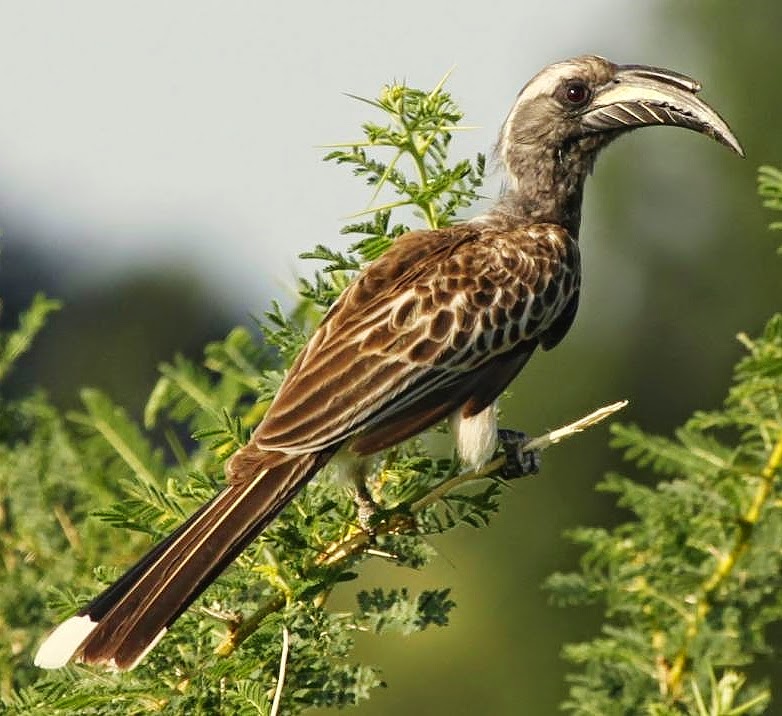
African grey hornbill

Tockus nasutus

Photo by Carmelo López (Internet Bird Collection)

Common name:
African grey hornbill (en); calau-cinzento (pt); calao à bec noir (fr); toco piquinegro (es); grautoko (de)

Taxonomy:
Order Coraciiformes
Family Bucerotidae

Range:
This species is found in sub-Saharan Africa, from south-western Mauritania and Guinea east to southern Sudan and Ethiopia, and south Namibia, Botswana and north-eastern South Africa. They are mostly absent from the Congo river basin. It also occurs along the Rea Sea coast of south-western Saudi Arabia and Yemen.

Size:
These birds are 43-51 cm long and weigh 160-230 g.

Habitat:
The African grey hornbill is mostly found in dry savannas and woodlands, also using tropical forests and dry grasslands. They are present from sea level up to an altitude of 1.500 m.

Diet:
They are mostly carnivorous, hunting rodents, frogs and bird eggs and nestlings, as well as spiders and large insects such as grasshoppers, beetles and caterpillars. They also take fruits such as figs, and peanuts.

Breeding:
African grey hornbills can breed all year round, varying among different parts of their range. They nest in a tree hole or sometimes on a rock crevice or abandoned barbet nest, which the female seals from the inside with her own faeces leaving just a small slit through which the males feeds her. She lays 2-5 eggs which she incubates alone for about 24 days. The chicks are fed by the female while the males provides her food, fledging 43-49 days after hatching. They only become fully independent a few weeks later.

Conservation:
IUCN status - LC (Least Concern)
This species has a very large breeding range and is reported to be widespread and common. The population is suspected to be stable in the absence of evidence for any declines or substantial threats.

Friday, 25 April 2014

African crested-flycatcher

Trochocercus cyanomelas

(Photo from Lee's Birdwatching Adventures)


Common name:
African crested-flycatcher (en); monarca-de-poupa (pt); tchitrec du Cap (fr); monarca de El Cabo (es); blaumantel-haubenschnäpper (de)

Taxonomy:
Order Passeriformes
Family Monarchidae

Range:
This African species is found from Uganda, Kenya and southern Somalia, though Tanzania, southern D.R. Congo, Zambia and Mozambique, and into eastern South Africa.

Size:
These birds are 14-15 cm long and weigh 10 g.

Habitat:
African crested-flycatchers are mostly found in the undergrowth of moist tropical forests, also using dry tropical forests and dry scrublands.

Diet:
They hunt small invertebrates, either by gleaning the foliage or on the wing.

Breeding:The African crested-flycatcher breeds in September-January. The nest is a thick-walled cup, made of bark fibres, moss, fine grass and lichen, bound together with spider webs.There the female lays 2-3 eggs which are incubated by both sexes. There is no information regarding the length of the incubation and fledgling periods.

Conservation:IUCN status - LC (Least Concern)
This species has a very large but patchy breeding range and is reported to be uncommon to frequent. The population is estimated to be in decline based on the lack of recent records in some areas.