Saturday, 28 June 2014

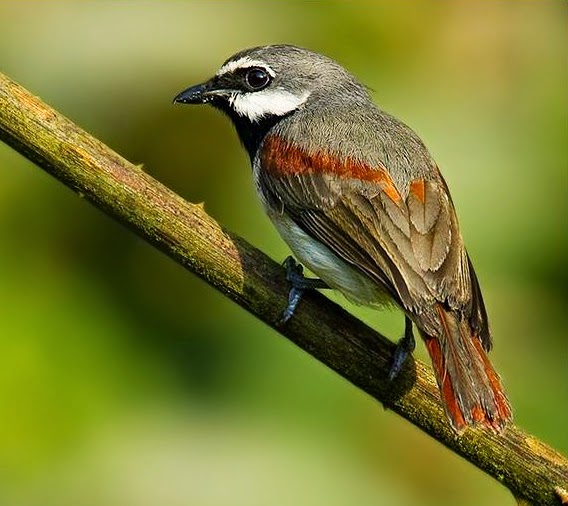
Blue-winged leafbird

Chloropsis cochinchinensis

Photo by C. Balakrishnan (JPG)

Common name:
blue-winged leafbird (en); verdim-d'asa-azul (pt); verdin à tête jaune (fr); verdín aliazul (es); blauflügel-blatvogel (de)

Taxonomy:
Order Passeriformes
Family Chloropseidae

Range:
This species is found from western Indonesia north to Myanmar and Laos, and marginally into southern China, extreme north-eastern India and Bangladesh.

Size:
These birds are 16-18 cm long and weigh 19-28,5 g.

Habitat:
The blue-winged leafbird is mostly found in lowland rainforests, but also use rainforests in mountainous areas, rural gardens and plantations. They are present from sea level up to an altitude of 1.800 m.

Diet:
They feed mainly on insects, but also fruits, berries and nectar.

Breeding:
Blue-winged leafbirds breed in February-July. They nest in an open cup made of fine stems, leaves and rootlets, typically placed on the ends of branches near the tree crown, or sometimes hanging from thin horizontal shoots, or attached to a pair of vertical twigs. The female lays 2-3 cream or pinkish eggs, which she incubates alone for 13-14 days while the male brings her food. The chicks are fed by both parents and fledge about 16 days after hatching.

Conservation:
IUCN status - LC (Least Concern)
This species has a very large breeding range and is described as relatively common throughout much of this range, although scarce in Singapore and rather rare in Java. The population is suspected to be in decline owing to ongoing habitat destruction.

Friday, 27 June 2014

Yellow-headed caracara

Milvago chimachima

Photo by Celuta Machado (Aves de Rapina Brasil)

Common name:
yellow-headed caracara (en); gavião-carrapateiro (pt); caracara à tête jaune (fr); chimachimá (es); gelbkopfkarakara (de)

Taxonomy:
Order Falconiformes
Family Falconidae

Range:
This species is found from Costa Rica south to northern Argentina and Uruguay, only east of the Andes mountain chain. They also occur in Trinidad and Tobago.

Size:
These birds are 40-46 cm long and have a wingspan of 81-95 cm. They weigh 280-360 g.

Habitat:
The yellow-headed caracara is mostly found in wet grasslands and savannas, but also uses scrublands, second growths and pastures. They are present from sea level up to an altitude of 2.600 m.

Diet:
They are generalist predators, taking reptiles and amphibians, insects and other invertebrates, small mammals, bird nestlings, carrion and human refuse. They are known to take ticks from cattle.

Breeding:
Yellow-headed caracaras breed in August-December. They nest in a stick platform placed on a scrub or tree, or also on termite mounds or man-made structures. The female lays 2-7 buff-coloured eggs with brown markings, which are incubated for about 22 days. The chicks fledge 17-20 days after hatching.

Conservation:
IUCN status - LC (Least Concern)
This species has an extremely large breeding range and is described as common. The population is increasing owing to deforestation and conversion of lowland forests into cattle ranches.

Thursday, 26 June 2014

Rufous gnateater

Conopophaga lineata

Photo by Arthur Grosset (Flickr)

Common name:
rufous gnateater (en); chupa-dente (pt); conopophage roux (fr); chupadientes (es); rotkehl-mückenfresser (de)

Taxonomy:
Order Passeriformes
Family Conopophagidae

Range:
This species is found in eastern Brazil, from Paraíba south to Rio Grande do Sul, and also in south-eastern Paraguay and extreme north-eastern Argentina.

Size:
These birds are 13-14 cm long and weigh 16-27 g.

Habitat:
The rufous gnateater is mostly found in dense understorey of moist tropical forests, but also use dry tropical forests and moist tropical scrublands. They are present at altitudes of 300-2.400 m.

Diet:
They forage in the forests understorey, taking various insects.

Breeding:
Rufous gnateaters nest in a cup made of sticks and moss placed on the ground or low in a small tree or scrub. The female lays 2 buff-coloured eggs which are incubated by both parents. The chicks are fed by both parents but there is no information regarding the length of the incubation and fledgling periods.

Conservation:
IUCN status - LC (Least Concern)
This species has a very large breeding range and is described as common. The population is suspected to be stable in the absence of evidence for any declines or substantial threats.

Wednesday, 25 June 2014

Noisy pitta

Pitta versicolor

Photo by H. Glover (CQC Landcare Network)

Common name:
noisy pitta (en); pita-ruídosa(pt); brève versicolore (fr); pita bulliciosa (es); lärmpitta (de)

Taxonomy:
Order Passeriformes
Family Pittidae

Range:
This species breeds along the eastern coast of Australia, from northern Queensland to southern New South Wales. The more northern populations migrate north to winter along the coast of southern New Guinea.

Size:
These birds are 17-21 cm long and weigh 70-130 g.

Habitat:
The noisy pitta is mostly found in rainforests, but also use dry woodlands and scrublands, mangroves and even urban areas. They are present from sea level up to an altitude of 1.500 m.

Diet:
They feed on insects and other invertebrates, including caterpillars, worms, centipedes, spiders and snails, even the giant panda snail Hedleyella falconeri, which it cracks open using a rock or another hard surface as anvil. They also take some fruits.

Breeding:

Noisy pittas breed in October-February. They nest on the ground, in a domed structure built by both sexes using sticks and dry leaves woven together with grasses. The nest is lined with moss and lichens, and placed in a concealed location, often among the buttresses of a tree. The female lays 3-4 eggs which are incubated by both parents for 15 days. The chicks are fed by both parents but there is no information regarding the length of the fledgling period.

Conservation:
IUCN status - LC (Least Concern)
This species has a large breeding range and is reported to be rare in New South Wales and locally moderately common in Queensland. The population is suspected to be in decline as a result of habitat degradation caused by agricultural expansion, loss of lowland rainforests and predation by introduced cats.

Tuesday, 24 June 2014

Flammulated owl

Otus flammeolus

Photo by Rick Bowers (Owl Pages)

Common name:
flammulated owl (en); mocho-flamado (pt); petit-duc nain (fr); autillo flamulado (es); Ponderosaeule (de)

Taxonomy:
Order Strigiformes
Family Strigidae

Range:
This species breeds in mountain patches from southern British Columbia and Alberta, in Canada, across most of the western United States and into Mexico as far south as Oaxaca. Most populations migrate south to winter from southern Mexico to El Salvador.

Size:
These small owls are 15-17 cm long and have a wingspan of 40 cm. They weigh 45-65 g.

Habitat:
The flammulated owl is found in mountain forests, in boreal temperate and tropical regions, favouring aspen, Ponderosa and Jeffrey pine forests with dense understorey, but also using mixed forests with oak, Douglas fir, white fir, incense cedar and sugar pine. They are present at altitudes of 1.500-3.000 m.

Diet:
They are insectivorous, hunting nocturnal insects such as beetles, moths and crickets, as well as spiders. They hunt from a perch, either taking their prey in flight, from the foliage or from the ground.

Breeding:
Flammulated owls are breed in April-August. They nest in a natural tree cavity or a woodpecker nest, sometimes also using nest boxes. The female lays 2-4 white eggs, which she incubates alone for 21-24 days while the male brings her food. The chicks are fed by both parents and fledge 30-35 days after hatching, but only become fully independent 4-5 weeks later.

Conservation:
IUCN status - LC (Least Concern)
This species has a large breeding range and the population is roughly estimated at 40.000 individuals. The population is suspected to be in decline owing to ongoing habitat destruction caused by timber harvesting.

Monday, 23 June 2014

White-breasted nuthatch

Sitta carolinensis

(Photo from Wikipedia)

Common name:
white-breasted nuthatch (en); trepadeira-de-peito-branco (pt); sittelle à poitrine blanche (fr); trepador pechiblanco (es); Carolinakleiber (de)

Taxonomy:
Order Passeriformes
Family Sittidae

Range:
This species is found throughout most of the United States, as well as in southern Canada and in Mexico as far south as Oaxaca.

Size:
These birds are 13-15 cm long and have a wingspan of 20-27 cm. They weigh 18-30 g.

Habitat:
The white-breasted nuthatch is mostly found in mature deciduous forests, particularly maple, hickory and oak, favouring open forests and forest edges. They also use mixed and coniferous forests, riparian vegetation, plantations, rural gardens and suburban parks and gardens. They are present at altitudes of 300-3.650 m.

Diet:
During spring and summer they feed mainly on spiders and insects such as weevil larvae, wood-boring beetle larvae, other beetles, tree hoppers, scale insects, ants, gall fly larvae, caterpillars, stink bugs, and click beetles. During the rest of the year they feed mainly on seeds and nuts, including acorns, hawthorn, sunflower seeds, and sometimes crops such as corn. They often visit bird feeders and store seeds in loose bark or crevices to consume later.

Breeding:
White-breasted nuthatches breed in April-June. They are monogamous and pair bonds can last over several years. They nest in a natural tree cavity or abandoned woodpecker nest, which the female lines with fur, bark and lumps of dirt on top of which she builds a cup made of fine grass, shredded bark, feathers, and other soft materials. The nest cavity is usually 3-18 m above the ground. The female lays 5-9 creamy white to pinkish-white eggs with reddish brown, grey, or purple speckles. She incubates the eggs alone for 12-14 days while the male brings her food. The chicks are fed by both parents and fledge about 26 days after hatching. Each pair raises a single brood per year.

Conservation:
IUCN status - LC (Least Concern)
This species has a very large breeding range and the global population is estimated at 9,2 million individuals. The population has undergone a large increase of 19% per decade over the last 4 decades. Still, since they rely on tree cavities to nest they are sensitive to the loss of mature forests.

Sunday, 22 June 2014

Red-tailed vanga

Calicalicus madagascariensis

Photo by Dubi Shapiro (Internet Bird Collection)

Common name:
red-tailed vanga (en); vanga-de-cauda-ruiva (pt); calicalic malgache (fr); vanga colirrojo (es); rotschwanzvanga (de)

Taxonomy:
Order Passeriformes
Family Vangidae

Range:
This species is endemic to Madagascar, being found in the north of the country and along the eastern and western coasts.

Size:
These birds are 13,5-14 cm long and weigh 14-18 g.

Habitat:
The red-tailed vanga is found in both dry and moist tropical forests, also using dry scrublands and second growths.

Diet:
They feed on insects and other arthropods, namely spiders, beetles, crickets, cockroaches, butterflies, bees, mantids, dragonflies, millipedes, and caterpillars and other larvae.

Breeding:
Red-tailed vangas nest in a cup made of lichens, moss, woven plant fibres and spider cocoons. It is lined with twigs and soft materials and placed in a fork in a tree. Both male and female help build the nest. The female lays 2 greenish-blue eggs with reddish brown spots, which are incubated by both parents for about 23 days. The chicks are fed by both parents and fledge about 15 days after hatching.

Conservation:
IUCN status - LC (Least Concern)
This species has a large breeding range and is described as common. There is no information regarding population trends, but the red-tailed vanga is not threatened at present.