Saturday, 14 June 2014

Black-browed albatross

Thalassarche melanophris

Photo by Jose Xavier (Antarctic Field Guide)


Common name:
black-browed albatross (en); albatroz-de-sobrancelha (pt); albatros à sourcils noirs (fr); albatros de ceja negra (es); schwarzbrauenalbatros (de)

Taxonomy:
Order Procellariiformes
Family Diomedeidae

Range:
This species has a circumpolar distribution, being found from the polar waters of Antarctica north to the coasts of southern Australia, Namibia and southern Mozambique in Africa and Peru and south-eastern Brazil in South America. They have breeding colonies in the Falkland Islands, Islas Diego Ramirez, Ildefonso, Diego de Almagro and Isla Evangelistas in Chile, South Georgia, Crozet and Kerguelen Islands in the Southern Ocean, Heard and McDonald Islands and Macquarie Island in Australia, and Campbell and Antipodes Islands in New Zealand.

Size:
These birds are 80-95 cm long and have a wingspan of 200-240 cm. They weigh 2,9-4,7 kg.

Habitat:
The black-browed albatross forages in oceanic waters, usually favouring shelf and shelf-break areas. They breed in steep slopes with tussock grass, sometimes on cliff terraces, or on flat ground along the shore line.

Diet:
They feed mainly on crustaceans, fish and squids, but also take carrion, fish discards and sometimes smaller seabirds such as Wildon's storm petrels Oceanites oceanicus. They show kleptoparasitic behaviour, stealing food from other species.

Breeding:
Black-browed albatrosses are monogamous and breed in large colonies that can count thousands of breeding pairs. They breed in September-April. The nest on the ground and the female lays a single egg which is incubated by both parents for 68-71 days. The chick is fed by both parents and fledge 120-130 days after hatching. They reach sexual maturity at 10 years of age.

Conservation:
IUCN - NT (Near-Threatened)
This species has an extremely large breeding range and a global population estimated at 1,4 million individuals. The main breeding population, in the Falkland Islands has shown an increase in recent decades, which outwheights declines elsewhere and justifies the estimate that the global population is increasing. Some breeding population are threatened by by-catch in long-line fisheries, while the explosion in European rabbit Oryctolagus cuniculus numbers on Macquarie Island led to an extensive destruction of habitat and soil erosion at nesting sites and cats are a problem in other islands. Conservation action underway include an eradication programme for rodents in Macquarie Island.

Friday, 13 June 2014

Cliff flycatcher

Hirundinea ferruginea

Photo by Dusan Brinkhuizen (Internet Bird Collection)

Common name:
cliff flycatcher (en); gibão-de-couro (pt); moucherolle hirondelle (fr); birro castaño (es); schwalbentyrann (de)

Taxonomy:
Order Passeriformes
Family Tyrannidae

Range:
This species has a disjunct distribution. Subspecies H.f. ferruginea found in the northern Amazon basin, in south-eastern Colombia, southern Venezuela, the Guyanas and north-western Brazil. H.f. sclateri is found along the eastern slopes of the Andes from Venezuela to southern Peru. H.f. pallidor is found from northern Bolivia to western Paraguay and north-western Argentina. Finally, H.f. bellicosa is found in the southern half of Brazil, into eastern Paraguay, Uruguay and north-eastern Argentina.

Size:
These birds are 16-18,5 cm long and weigh about 20 g.

Habitat:
The cliff flycatcher is mostly found around cliff and rocky canyons, landslides and steep banks bordered by secondary or mature tropical forest, but can also use similar man-made habitats such as cuttings, bridges and quarries, ledges and building facades and nearby scrublands. They are present from sea level up to an altitude of 3.900 m.

Diet:
They sally out from a perch to hawk various flying insects.

Breeding:
Cliff flycatchers nest on an open cup made of vegetable fibres and grasses, which is bordered by a ring of stones. The nest is placed in a ledge or crevice in a rock face or on a man-made structure such as a bridge or building.The female lays 2-3 white eggs with rusty spots, which she incubates alone for 2 weeks. The chicks are fed by both parents and fledge about 15 days after hatching.

Conservation:
IUCN status - LC (Least Concern)
This species has a very large breeding range and is described as fairly common but patchily distributed. The populations is thought to be increasing in numbers and spreading into artificial habitats due to their new nesting behaviour on man-made structures, providing them numerous nest-sites.

Thursday, 12 June 2014

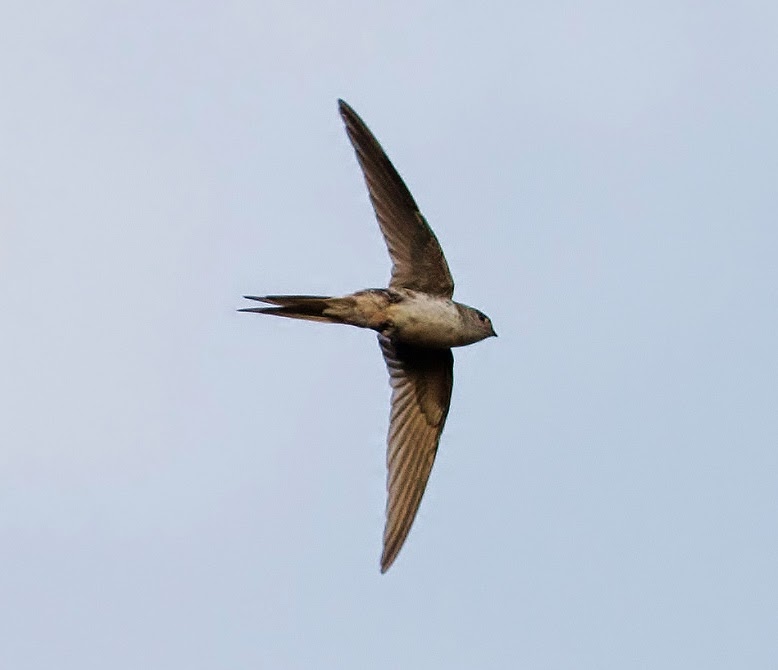
Fork-tailed palm-swift

Tachornis squamata

Photo by Dave Curtis (Flickr)

Common name:
fork-tailed palm-swift (en); andorinhão-do-buriti (pt); martinet claudia (fr); vencejillo tijereta (es); gabelschwanzsegler (de)

Taxonomy:
Order Apodiformes
Family Apodidae

Range:
This species is found in northern South America, east of the Andes. they are present from Colombia, Venezuela and the Guyanas south to Bolivia and southern Brazil as far as Mato Grosso do Sul and São Paulo.

Size:
These birds are 11,5-14 cm long and weigh 11 g.

Habitat:
The fork-tailed palm-swift is mostly found in dry tropical forests, but also uses moist tropical forests, wet grasslands, marshes, second growths and urban areas. They are present at altitudes of 200-900 m.

Diet:
They forage on the wing, taking various flying insects.

Breeding:
These birds nest on a small cup made of feathers, saliva and plant material, placed on the inside of a dead leaf of a moriche palm Mauritia flexuosa. The female lays 2-4 white eggs which she incubates for 19-21 days. There is no available information regarding the fledgling period.

Conservation:
IUCN status - LC (Least Concern)
This species has a very large breeding range and is is described as common. The population is suspected to be stable in the absence of evidence for any declines or substantial threats.

Wednesday, 11 June 2014

Coal-crested finch

Charitospiza eucosma

Photo by Tancredo Maia (Flickr)

Common name:
coal-crested finch (en); mineirinho (pt); charitospize charbonnier (fr); monterita crestada (es); weißwangen-zwergkardinal (de)

Taxonomy:
Order Passeriformes
Family Emberizidae

Range:
This species is patchily distributed across north-eastern and central Brazil, in central Piauí, southern Maranhão and south-eastern Pará south through Goiás, western Bahia and central Minas Gerais to south-eastern Mato Grosso and central São Paulo. Also in north-eastern Bolivia, in Serranía de Huanchaca in Santa Cruz, and north-eastern Argentina.

Size:
These birds are 11-11,5 cm long and weigh 10-12 g.

Habitat:
The coal-crested finch is mostly found in cerrado dry savannas, also using savanna-grasslands transition habitatsand semi-open arid caatinga scrublands. They specialize in recently burned areas. This species is present at altitudes of 200-1.200 m.

Diet:
They are omnivorous, mainly eating grass seeds and arthropods, but also fruits and flowers. They are known to consume grasses such as Echinolaena inflexa, Trachypogon spp. and Aristida spp. and the introduced Andropogon gayanus, as well as grasshoppers, crickets, ants, termites and insect eggs.

Breeding:
Coal-crested finches are socially monogamous, although there are some cases of polygyny. They ave two breeding seasons, responding to the local rainy seasons, in September-December and February-April. The nest is built by both sexes, consisting of an open cup made of dry grasses, small twigs, spider webs, fine roots and silk cotton. It is placed in a tree, 1-4 m above the ground. The female lays 1-3 pale blue-green eggs with brown spots, which she incubates alone for 10-12 days. The chicks are fed by both parents and fledge 10-15 days after hatching.

Conservation:
IUCN status - NT (Near-Threatened)
This species has a relatively large but patchy breeding range. Although the global population size has not been quantified, this species is described as uncommon and patchily distributed, and suspected to be declining at a slow to moderate rate. The main threat is habitat loss through conversion to agriculture for Eucalyptus plantations, soy beans and pastures for exportable crops, which is encouraged by government land reform and has had a severe impact on the cerrado habitats in Brazil. They are also trapped for the cage bird trade.

Tuesday, 10 June 2014

Bronze munia

Lonchura cucullata

Photo by Warwick Tarboton (Warwick Tarboton)

Common name:
bronze munia (en); bico-de-chumbo-bronzeado (pt); capucin nonnette (fr); capuchino bronceado (es); kleinelsterchen (de)

Taxonomy:
Order Passeriformes
Family Estrildidae

Range:
This species is found in sub-Saharan Africa, from Senegal east to Ethiopia and south to Angola, eastern Botswana and eastern South Africa. There is also an introduced population in Puerto Rico.

Size:
These birds are 9-10 cm long and weigh 10-12 g.

Habitat:
The bronze munia is found in tropical forests and savannas, dry scrublands, dry grasslands, inland wetlands such as marshes and swamps, and also in pastures and arable land.

Diet:
They forage on the ground or in low vegetation, mainly taking grass seeds and cultivated cereals such as rice. They also take some insects, such as termites and ants, and occasionally nectar.

Breeding:
Bronze munias can breed all year round. The nest is built by both sexes, consisting of a domed structure made of grasses and lined with feather and soft plant fibres, placed in a small tree 2-3 m above the ground. It is usually located near wasp on ant nests. The female lays 4-8 eggs which are incubated by both parents for 12-14 days. The chicks fledge 17-21 days after hatching but only become fully independent 3 weeks later. Each pair can raise multiple broods per year.

Conservation:
IUCN status - LC (Least Concern)
This species has a very large breeding range and is described as common and widespread. The population is suspected to be stable in the absence of evidence for any declines or substantial threats.

Monday, 9 June 2014

Dusky lory

Pseudeos fuscata

Photo by Greg Hume (Wikipedia)

Common name:
dusky lory (en); lóri-sombrio (pt); lori sombre (fr); lori sombrío (es); weißbürzellori (de)

Taxonomy:
Order Psittaciformes
Family Psittacidae

Range:
This species is found throughout the island of New Guinea and in the nearby islands of Sulawata and Yapen.

Size:
These birds are 24-27 cm long and weigh 140-190 g.

Habitat:
The dusky lory is found in a wide range of habitats including rainforests, mangroves, moist savannas, scrublands, second growths, plantations, rural gardens and even urban areas. They are present from sea level up to an altitude of 2.400 m.

Diet:
They feed on seeds, fruits, buds, nectar, pollen and unripe grain.

Breeding:
Dusky lories breed in August-November. They nest in a hole high up on a tree, where the female lays 2-3 white eggs. The eggs are incubated for 24 days and the chicks fledge 10 weeks after hatching.

Conservation:
IUCN status - LC (Least Concern)
This species has a large breeding range and is is reported to be common and highly gregarious. The population is suspected to be stable in the absence of evidence for any declines or substantial threats.

Sunday, 8 June 2014

Hawfinch

Coccothraustes coccothraustes

Photo by Eduardo Balogh (Trek Nature)

Common name:
hawfinch (en); bico-grossudo (pt); gros-bec casse-noyaux (fr); picogordo común (es); kernbeißer (de)

Taxonomy:
Order Passeriformes
Family Fringillidae

Range:
This species is found throughout most of Europe, from the Iberian Peninsula north to Britain and southern Scandinavia and east into Turkey and Russia, along the Caucasus and southern Russia into northern Kazakhstan, northern Mongolia and north-eastern China. There are also population in Iran, between Uzbekistan and western China, and in northern Africa from Morocco to Tunisia. The populations in Europe are mostly resident, but the most Asian population migrate to winter around the Mediterranean, and in south-eastern China, Korea and Japan.

Size:
These birds are 16,5-18 cm long and have a wingspan of 29-33 cm. They weigh 48-62 g.

Habitat:
The hawfinch is mostly found in temperate forests, mainly oak and other deciduous trees but also mixed and coniferous forests. They also use rural gardens as well as urban parks and gardens.

Diet:
They feed mainly on seeds, being able to crack open seeds and large as cherry pits and almonds with their strong beak. They also take buds, shoots of various tree and scrubs. During the breeding season also caterpillars.

Breeding:
Hawfinches breed in March-July. They can either nest in individual pairs or often in small colonies. Each nest is a bulky structure made of dry twigs, with an inner cup made of roots grasses, twigs, dry moss, and lichens. It is usually placed in a large tree. The female lays 4-6 whitish eggs with dark brown blotches, which she incubates alone for 11-14 days while the male brings her food. The chicks fledge 10-14 days after hatching. Each pair usually raises a single clutch per year, but in very favourable years they may raise a second clutch.

Conservation:
IUCN status - LC (Least Concern)
This species has an extremely large breeding range and a global population estimated at 14,7-50,4 million individuals. The population is suspected to be stable in the absence of evidence for any declines or substantial threats and data for part of Europe show a stable trend over the last 3 decades.